 It currently takes 90 minutes to transmit high-resolution images from Mars, but NASA would like to dramatically reduce that time to just minutes. A new optical communications system that NASA plans to demonstrate in 2016 will lead the way and even allow the streaming of high-definition video from distances beyond the Moon.This dramatically enhanced transmission speed will be demonstrated by the Laser Communications Relay Demonstration (LCRD), one of three projects selected by NASA's Office of the Chief Technologist (OCT) for a trial run. To be developed by a team led by engineers at the NASA Goddard Space Flight Center in Greenbelt, Md., LCRD is expected to fly as a hosted payload on a commercial communications satellite developed by Space Systems/Loral, of Palo Alto, Calif."We want to take NASA's communications capabilities to the next level," said LCRD Principal Investigator Dave Israel, who is leading a multi-organizational team that includes NASA's Jet Propulsion Laboratory, Pasadena, Calif. and Lincoln Laboratory at the Massachusetts Institute of Technology, Cambridge, Mass. Although NASA has developed higher data-rate radio frequency systems, data-compression, and other techniques to boost the amount of data that its current systems can handle, the Agency's capabilities will not keep pace with the projected data needs of advanced instruments and future human exploration, Israel added."Just as the home Internet user hit the wall with dial-up, NASA is approaching the limit of what its existing communications network can handle," he said.The solution is to augment NASA's legacy radio-based network, which includes a fleet of tracking and data relay satellites and a network of ground stations, with optical systems, which could increase data rates by anywhere from 10 to 100 times. "This transition will take several years to complete, but the eventual payback will be very large increases in the amount of data we can transmit, both downlink and uplink, especially to distant destinations in the solar system and beyond," said James Reuther, director of OCT's Crosscutting Technology Demonstrations Division.First StepThe LCRD is the next step in that direction, Israel said, likening the emerging capability to land-based fiber-optic systems, such as Verizon's FiOS network. "In a sense, we're moving FiOS to space."To demonstrate the new capability, the Goddard team will encode digital data and transmit the information via laser light from specially equipped ground stations to an experimental payload hosted on the commercial communications satellite. To View This Sites: Gas Grills
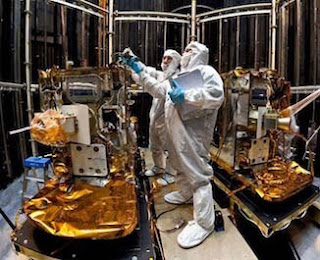 CAPE CANAVERAL, Fla. NASA's Gravity Recovery And Interior Laboratory (GRAIL) mission to study the moon is in final launch preparations for a scheduled Sept. 8 launch from Cape Canaveral Air Force Station in Florida.
GRAIL's twin spacecraft are tasked for a nine-month mission to explore Earth's nearest neighbor in unprecedented detail. They will determine the structure of the lunar interior from crust to core and advance our understanding of the thermal evolution of the moon.
"Yesterday's final encapsulation of the spacecraft is an important mission milestone," said David Lehman, GRAIL project manager for NASA's Jet Propulsion Laboratory in Pasadena, Calif. "Our two spacecraft are now sitting comfortably inside the payload fairing which will protect them during ascent. Next time the GRAIL twins will see the light of day, they will be about 95 miles up and accelerating."
The spacecraft twins, GRAIL-A and GRAIL-B, will fly aboard a Delta II rocket launched from Florida. The twins' circuitous route to lunar orbit will take 3.5 months and cover approximately 2.6 million miles (4.2 million kilometers) for GRAIL-A, and 2.7 million miles (4.3 million kilometers) for GRAIL-B.
In lunar orbit, the spacecraft will transmit radio signals precisely defining the distance between them. Regional gravitational differences on the moon are expected to expand and contract that distance.
GRAIL scientists will use these accurate measurements to define the moon's gravity field. The data will allow mission scientists to understand what goes on below the surface of our natural satellite.
"GRAIL will unlock lunar mysteries and help us understand how the moon, Earth and other rocky planets evolved as well," said Maria Zuber, GRAIL principal investigator from the Massachusetts Institute of Technology in Cambridge.
GRAIL's launch period opens Sept. 8 and extends through Oct. 19. On each day, there are two separate launch opportunities separated by approximately 39 minutes. On Sept. 8, the first launch opportunity is 8:37 a.m. EDT (5:37 a.m. PDT); the second is 9:16 a.m. EDT (6:16 a.m. PDT).
NASA's Jet Propulsion Laboratory, Pasadena, Calif., manages the GRAIL mission. The Massachusetts Institute of Technology, Cambridge, is home to the mission's principal investigator, Maria Zuber. The GRAIL mission is part of the Discovery Program managed at NASA's Marshall Space Flight Center in Huntsville, Ala. Lockheed Martin Space Systems, Denver, built the spacecraft. Launch management for the mission is the responsibility of NASA's Launch Services Program at the Kennedy Space Center in Florida. JPL is a division of the California Institute of Technology in Pasadena.
CAPE CANAVERAL, Fla. NASA's Gravity Recovery And Interior Laboratory (GRAIL) mission to study the moon is in final launch preparations for a scheduled Sept. 8 launch from Cape Canaveral Air Force Station in Florida.
GRAIL's twin spacecraft are tasked for a nine-month mission to explore Earth's nearest neighbor in unprecedented detail. They will determine the structure of the lunar interior from crust to core and advance our understanding of the thermal evolution of the moon.
"Yesterday's final encapsulation of the spacecraft is an important mission milestone," said David Lehman, GRAIL project manager for NASA's Jet Propulsion Laboratory in Pasadena, Calif. "Our two spacecraft are now sitting comfortably inside the payload fairing which will protect them during ascent. Next time the GRAIL twins will see the light of day, they will be about 95 miles up and accelerating."
The spacecraft twins, GRAIL-A and GRAIL-B, will fly aboard a Delta II rocket launched from Florida. The twins' circuitous route to lunar orbit will take 3.5 months and cover approximately 2.6 million miles (4.2 million kilometers) for GRAIL-A, and 2.7 million miles (4.3 million kilometers) for GRAIL-B.
In lunar orbit, the spacecraft will transmit radio signals precisely defining the distance between them. Regional gravitational differences on the moon are expected to expand and contract that distance.
GRAIL scientists will use these accurate measurements to define the moon's gravity field. The data will allow mission scientists to understand what goes on below the surface of our natural satellite.
"GRAIL will unlock lunar mysteries and help us understand how the moon, Earth and other rocky planets evolved as well," said Maria Zuber, GRAIL principal investigator from the Massachusetts Institute of Technology in Cambridge.
GRAIL's launch period opens Sept. 8 and extends through Oct. 19. On each day, there are two separate launch opportunities separated by approximately 39 minutes. On Sept. 8, the first launch opportunity is 8:37 a.m. EDT (5:37 a.m. PDT); the second is 9:16 a.m. EDT (6:16 a.m. PDT).
NASA's Jet Propulsion Laboratory, Pasadena, Calif., manages the GRAIL mission. The Massachusetts Institute of Technology, Cambridge, is home to the mission's principal investigator, Maria Zuber. The GRAIL mission is part of the Discovery Program managed at NASA's Marshall Space Flight Center in Huntsville, Ala. Lockheed Martin Space Systems, Denver, built the spacecraft. Launch management for the mission is the responsibility of NASA's Launch Services Program at the Kennedy Space Center in Florida. JPL is a division of the California Institute of Technology in Pasadena.

 It currently takes 90 minutes to transmit high-resolution images from Mars, but NASA would like to dramatically reduce that time to just minutes. A new optical communications system that NASA plans to demonstrate in 2016 will lead the way and even allow the streaming of high-definition video from distances beyond the Moon.
